
Skip to content

(860) 791-1424Free referral line, independent service. How it works

Connecticut Garage Door Repair

Garage Door Replacement in Connecticut

When repairs keep stacking up, sections are damaged beyond matching, or the door is simply worn out, a new door can be the better spend. Here's what a replacement costs and what to get in writing in Connecticut.

Free referral anywhere in Connecticut — Call (860) 791-1424

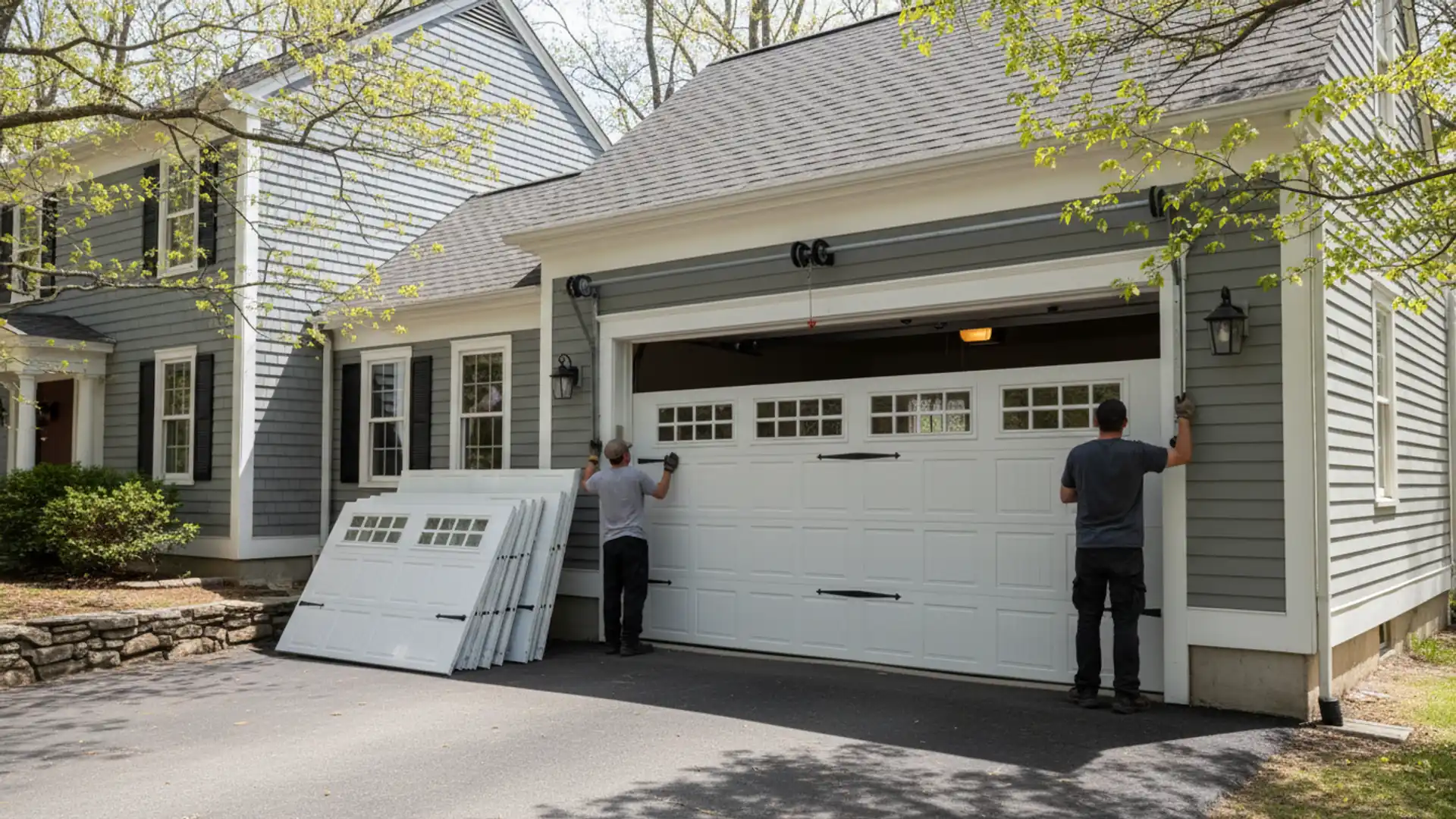
Newly installed insulated steel carriage-style garage door on a two-car attached garage at a Connecticut colonial

Free referral · No obligation

Get Connected for a New Garage Door

Call to be connected with a participating independent garage door company that serves your area. No obligation to hire.

Last updated: 2026-10-11

Connecticut Garage Door Repair is a referral service that connects Connecticut homeowners with participating garage door companies for garage door replacement in CT and new garage door installation. A new door usually includes new sections, tracks, springs sized to the new door's weight, rollers, cables, and weatherstripping, and often a new opener.

When replacement makes more sense than repair

A new door is worth pricing when one or more of these is true:

  • Several sections are damaged, or your model is discontinued so sections can't be matched.
  • The door is decades old, single-layer, and drafty, and the garage is attached to living space.
  • Wood panels have rotted at the bottom and the frame is going soft.
  • You've paid for two or three significant repairs in a few years.
  • The door is an old one-piece tilt-up or lacks safe hardware, like extension springs without safety cables.

Materials and insulation

HomeAdvisor's June 2026 per-door material ranges: steel $650 to $3,200, wood $900 to $4,500, aluminum $600 to $2,900, fiberglass $800 to $2,700, composite $650 to $4,800, and vinyl $800 to $2,500. Steel is the budget-friendly, low-upkeep option; wood and composite carriage-house styles suit Connecticut's older colonials and capes.

Insulation matters most when the garage shares a wall or a bedroom ceiling with the house. HomeAdvisor puts an insulation upgrade at $600 to $3,000. An insulated door is also heavier, which is why the springs must be sized to the new door, not reused from the old one.

Wind ratings and permits in Connecticut

Connecticut's building code is based on the 2021 International Residential Code, which requires garage doors to meet wind-load design pressures, tested to ANSI/DASMA 108. Most of the state falls in the lower design wind-speed zones, and the stricter wind-borne debris rules cover only the eastern shoreline from Madison to the Rhode Island border, south of I-95. A reputable installer will know the rating your location needs.

Whether a replacement needs a building permit depends on your town and the scope of the work. Ask the company whether they pull the permit, and if one is required, make sure it's closed out with an inspection.

Contracts and deposits for a new door

A new door is the kind of job Connecticut's home improvement rules were written for. The contract must be in writing, signed and dated by both of you, show the contractor's HIC registration number, describe the door and work, give the price and start and completion dates, and include your right to cancel until midnight of the third business day (Saturday counts). The Department of Consumer Protection suggests keeping the deposit to about one-third of the job, and asking for proof of liability insurance of at least $20,000.

When to call about a new door

  • You've been told a damaged section can't be matched.
  • Repair quotes are approaching the cost of a new door.
  • The door is old, drafty, and on an attached garage.
  • Wood sections are rotting or the door is visibly sagging.
  • You want a quieter, insulated door or a different style.

What garage door replacement costs

HomeAdvisor's June 2026 data puts the average garage door replacement at $1,231, with most between $754 and $1,707. By size: single-car doors $500 to $3,000, two-car doors $800 to $5,000, and three-car doors $1,400 to $7,200. Labor is typically $200 to $500, averaging $350. Connecticut labor generally runs toward the upper end of national ranges.

  • Size: one, two, or three-car width, and height above the standard 7 feet.
  • Material and style: plain steel is the least expensive; wood, composite carriage-house, and full-view glass cost more.
  • Insulation: polystyrene vs. polyurethane, and R-value.
  • Windows and hardware: decorative windows, handles, and hinges.
  • New opener: often recommended with a heavier insulated door; $250 to $500+ installed.
  • Removal and disposal of the old door, and any framing or trim repair.
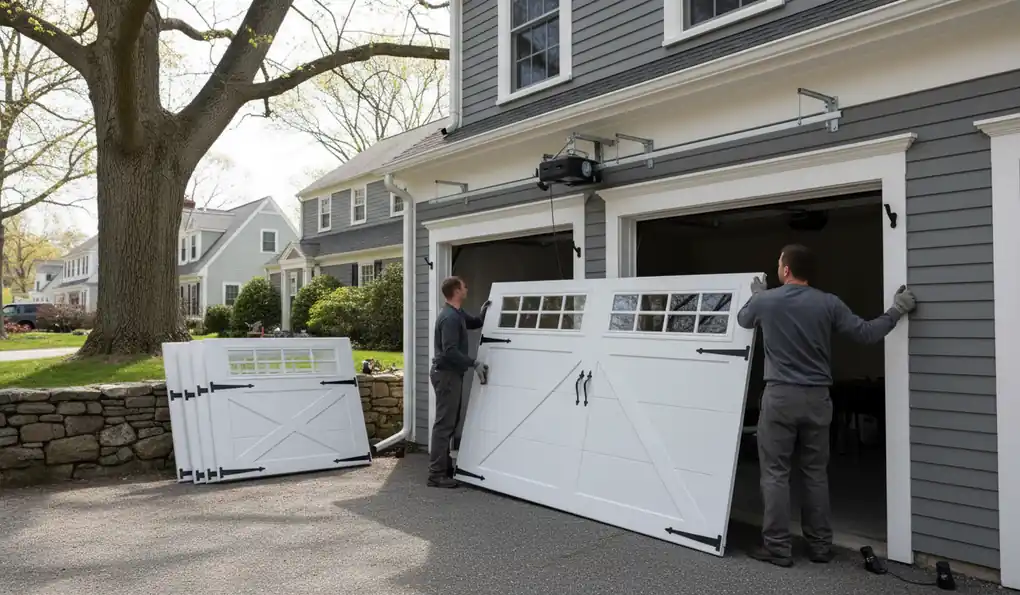
Installer setting the bottom section of a new sectional garage door into the tracks

How to get started

  1. Measure the door opening's width and height, and the headroom above it.
  2. Decide whether insulation matters (attached garage, room above).
  3. Get at least two written quotes with the door model, R-value, and every line item.
  4. Look up each company's HIC number on eLicense.
  5. Keep the deposit to about one-third, and don't sign a contract without the cancellation notice.

Questions to ask before you hire

  • What is your Connecticut HIC registration number, and can I see proof of liability insurance?
  • What door model, material, insulation, and wind rating are you quoting?
  • Are new tracks, springs, cables, and weatherstripping included?
  • Do you pull the permit if one is required, and who schedules the inspection?
  • What warranties come with the door, the springs, and the installation labor?

Related garage door guides

Straight answers

What you can safely check vs. when to call

The safe homeowner checks are short on purpose. Springs, cables, and the brackets they attach to hold enough tension to cause serious injury, so anything involving them belongs to a technician.

What the door is doingSafe for you to checkCall a garage door companyStop and keep everyone clear
Won't open at allOpener plugged in and the outlet works; door lock not engaged; wall button vs. remoteYou heard a loud bang, or the opener hums but the door doesn't moveThe door is open and won't come down: don't walk under it
Starts to close, then reversesPhoto eyes 4 to 6 inches off the floor: clean the lenses, make sure nothing blocks them and both lights are steadyIt still reverses with the eyes clear and alignedNever tape over or bypass the photo eyes
Hangs crooked or one side is lowerNothing. Look from a distance for a loose or snapped cableRight away, before using it againDon't run the opener; a crooked door can jump the track
Off the trackNothing past unplugging the openerRight awayKeep cars and kids out of the doorway
Opener strains or the door barely liftsFrom the floor, look at the springs above the door for a gap in the coilA broken or worn-out spring is the usual causeDon't lift it by hand or pull the release with the door open: it can drop
Gap in a spring above the doorNothing. A visible gap in the coil means the spring brokeAlwaysDon't touch the spring, the cones, or the bottom brackets

General guidance, not a diagnosis. Photo-eye height comes from the federal opener safety rule, 16 CFR Part 1211. If something looks unsafe, treat it as unsafe.

What to expect

What a garage door replacement usually involves

Every door is different. These are the stages most residential garage door repairs go through.

  1. Measure and choose

    The company measures the opening, headroom, and side room, and helps you choose the door, insulation, and options.

  2. Written contract

    Connecticut requires a written, signed, dated contract with the HIC number, the work, the price, the dates, and your three-day right to cancel. DCP suggests a deposit of about one-third.

  3. Ordering

    Most doors are built to order. Ask for the expected delivery and installation date in writing.

  4. Removal and installation

    The old door's spring tension is released safely, the door removed, and the new tracks, sections, springs, and cables installed.

  5. Balance, opener, and walkthrough

    The new door is balanced, the opener programmed and its safety reverse tested, and you're shown the manual release and care.

How the referral works

How our garage door referral line works

  1. You call the number on this site

    Have the address or ZIP code ready, plus what the door is doing: stuck, crooked, reversing, off its track, or making a bang when it tried to open.

  2. Your call is routed to a participating company

    Your call is connected with a participating independent garage door company that serves your area, if one is available. We don't send anyone ourselves, and the companies in our name-only directory are not our participants.

  3. You deal with that company directly

    The company inspects the door, quotes the job, and does any work you agree to under its own business name, HIC registration, and insurance. You decide whether to hire them. There is no obligation.

Good to know: availability depends on which participating companies cover your ZIP code and when you call. Whoever you hire, ask for their Connecticut HIC registration number and look it up on eLicense before you sign. Our guide to checking a garage door company shows how.

Get Connected for a New Garage Door

Call and we will try to connect you with a participating independent garage door company that serves your area.

Questions

Garage Door Replacement questions

How much does a new garage door cost in Connecticut?

HomeAdvisor's June 2026 data puts the average replacement at $1,231, with most between $754 and $1,707. Two-car doors range from $800 to $5,000 depending on material and options. Connecticut prices usually sit toward the upper end of national ranges.

Do I need a permit to replace a garage door in Connecticut?

It depends on your town and the scope of the work. Ask the company whether a permit is required and whether they pull it; if so, make sure the job gets its final inspection.

Do garage doors need to be wind-rated in Connecticut?

Connecticut's building code, based on the 2021 International Residential Code, requires garage doors to meet wind-load design pressures tested to ANSI/DASMA 108. The stricter wind-borne debris rules apply only along the eastern shoreline from Madison to Rhode Island.

How much deposit should I pay for a new garage door?

Connecticut's Department of Consumer Protection suggests limiting a home improvement deposit to about one-third of the job. Get a written contract with the contractor's HIC number and your three-day cancellation notice before you pay.

Should I replace the opener with the door?

Often, if the opener is old or lacks photo-eye safety sensors, or if the new insulated door is much heavier. If the opener is recent and rated for the new door, it can usually stay.

Call (860) 791-1424 · Garage Door Help