
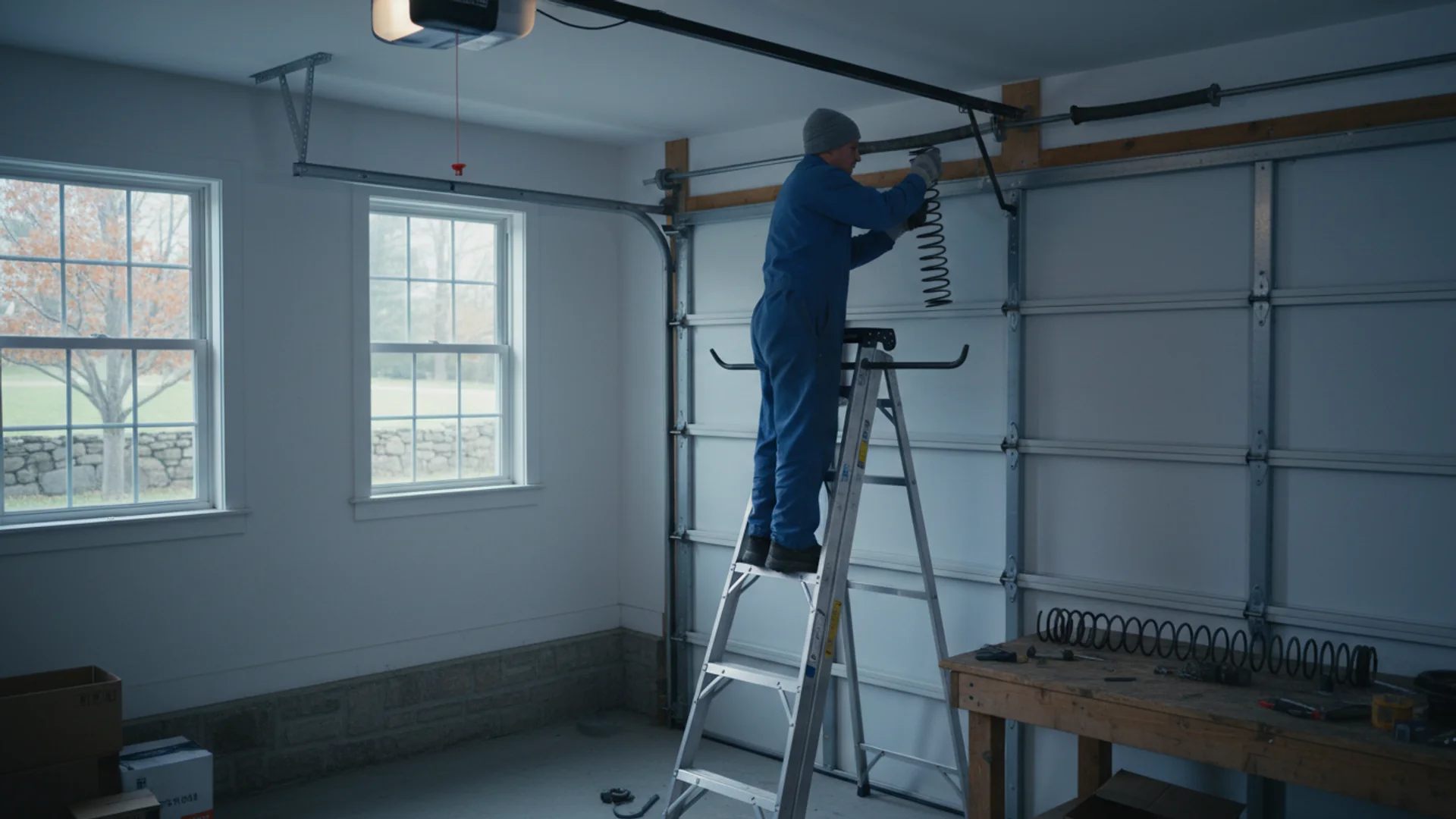
Last updated: 2026-10-11
Connecticut Garage Door Repair is a referral service that connects Connecticut homeowners with participating garage door companies for garage door spring repair. The springs do the heavy lifting on a garage door: they counterbalance the door's weight so the opener (or your arm) only has to guide it. When a spring breaks, the door suddenly feels like dead weight. Spring replacement is the most common garage door repair, and it is not a do-it-yourself job.
Signs your garage door spring is broken
Most people find out the same way: a sharp bang from the garage, often in the morning or during a cold snap, and the next time the door is opened it barely moves. These are the common signs:
- A gap in the coil. On a torsion spring (mounted on the bar above the door), a broken spring shows a 2-inch or larger gap where the coil snapped.
- The opener strains or the door lifts a few inches and stops. Many openers sense the extra weight and reverse.
- The door slams down or falls fast when it gets near the floor.
- The door goes up crooked on a door with two extension springs (along the side tracks) when one side has broken.
- Loose or slack cables hanging beside the door, because the spring that kept them tight is no longer pulling.
Torsion vs. extension springs
Most newer doors use torsion springs: one or two tightly wound springs on a steel shaft above the door, which turn the cable drums as the door moves. Older doors, and many single-car doors on detached garages, use extension springs that stretch along each horizontal track.
HomeAdvisor's June 2026 cost data rates torsion springs at 10,000 to 20,000 cycles (roughly 8 to 15 years) and extension springs at 8,000 to 15,000 cycles (7 to 12 years). One cycle is one open and one close. A household that uses the garage as its main entrance can easily run four cycles a day, about 1,460 a year, which wears out a standard 10,000-cycle spring in about seven years.
Extension springs should always have a safety cable threaded through them so a broken spring can't fly across the garage. If yours don't, mention it when you call. HomeAdvisor puts converting a door from extension to torsion springs at $400 to $800, which some owners choose when the springs fail on an older door.
Why springs break sooner in some Connecticut garages
Springs are steel under constant load, so the things that weaken steel shorten their life. The garage door industry's own technical guidance (DASMA Technical Data Sheet 190) says rust reduces the effective area of the spring wire and creates corrosion pits where fatigue cracks start. That matters in shoreline towns like Stamford, Bridgeport, and New Haven, where salt air reaches unheated garages, and in any garage where snowmelt off the car keeps the floor wet all winter.
The same guidance warns that adding weight to a door (paint, insulation panels, decorative hardware) can push it past what the springs were sized for. A spring that is undersized for the door it lifts wears out early. If your door was insulated or re-skinned after it was installed, tell the technician.
Why spring replacement isn't a DIY job
A torsion spring is wound under high tension, and the bottom brackets and cables are under the same load. Unwinding or winding one takes winding bars, the correct spring size for the door's weight and height, and a technician who does it every day. Searching for a how-to video is how people get hurt. Leave the door closed, unplug the opener, and keep the car out of the doorway until it's fixed.
If the door is stuck open with a broken spring, don't pull the red emergency release: without the spring the door can drop all at once. See our guide to whether a broken garage door spring is dangerous for what is and isn't safe to do.
When to call about a spring
- You heard a loud bang and the door now won't open or barely lifts.
- You can see a gap in a torsion spring, or an extension spring is hanging loose.
- The door drops fast, slams, or won't stay halfway open.
- The door is at least 7 to 10 years old and the springs have never been replaced; the second one usually isn't far behind the first.
- Extension springs have no safety cable running through them.
What garage door spring repair costs
HomeAdvisor's June 2026 data puts spring replacement at an average of $250, with most jobs between $150 and $350. Its per-spring figures, parts and labor, are $75 to $150 for a torsion spring and $50 to $100 for an extension spring. Connecticut labor generally runs toward the higher end of national ranges: the Bureau of Labor Statistics puts the state's median repair-worker wage about 16% above the national median.
Most technicians recommend replacing both springs on a two-spring door at the same time, because they have done the same number of cycles and the second one is close to failing. That is a legitimate recommendation. A quote of several hundred dollars per spring for a standard residential door is not: NBC Connecticut reported a Burlington homeowner shown a screenshot claiming each spring cost over $700. If a price seems high, get a second quote and ask for the spring sizes and part prices in writing.
- Number of springs: one or two on a torsion system; always two on an extension system.
- Door size and weight: a heavier or taller door needs larger springs.
- Spring grade: high-cycle springs (20,000+ cycles) cost more up front and last longer.
- Other worn parts: frayed cables ($75 to $200 per HomeAdvisor), cracked cones, or worn rollers found during the visit.
- Timing: evening and weekend calls often carry an extra fee; ask before the technician comes out.
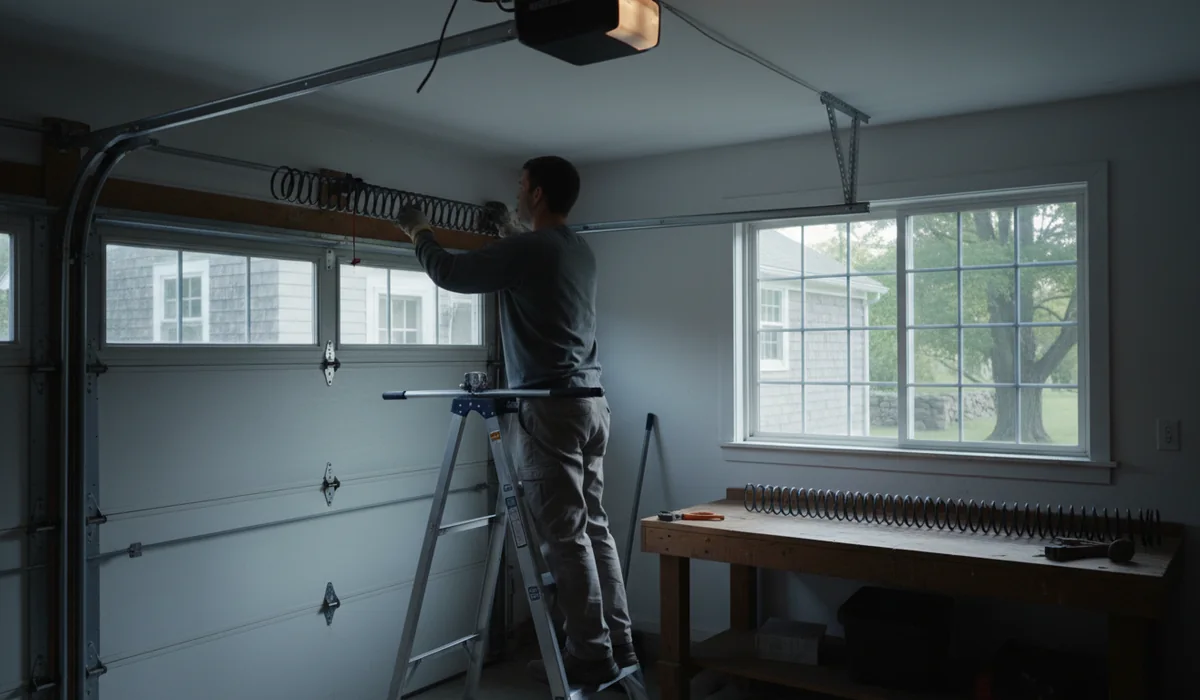
What to do right now
- Stop using the opener and unplug it so nobody runs it by accident.
- If the door is closed, leave it closed. If it's stuck open, keep cars, kids, and pets out from under it.
- From the floor, look at the springs and cables so you can describe what you see. Don't touch them.
- Measure the door's width if you can do it from the inside without moving the door.
- Call, describe the bang and what the door does now, and ask for the price of the springs and labor before anyone starts.
Questions to ask before you hire
- What is your Connecticut HIC registration number? (Look it up on eLicense before you sign.)
- Are you replacing one spring or both, and why?
- What size and cycle rating are the new springs, and what does each one cost?
- Is there a trip charge or after-hours fee, and is it waived if I go ahead with the repair?
- What warranty comes with the springs and the labor, and is it in writing?