
Decision Guide
Torsion springs mount on a bar above the door, last longer (10,000 to 20,000 cycles per HomeAdvisor), and keep their energy contained; they cost $75 to $150 each to replace. Extension springs stretch along the side tracks, last 8,000 to 15,000 cycles, cost $50 to $100 each, and must have safety cables. Converting runs $400 to $800.
Published 2026-10-11 · Updated 2026-10-11
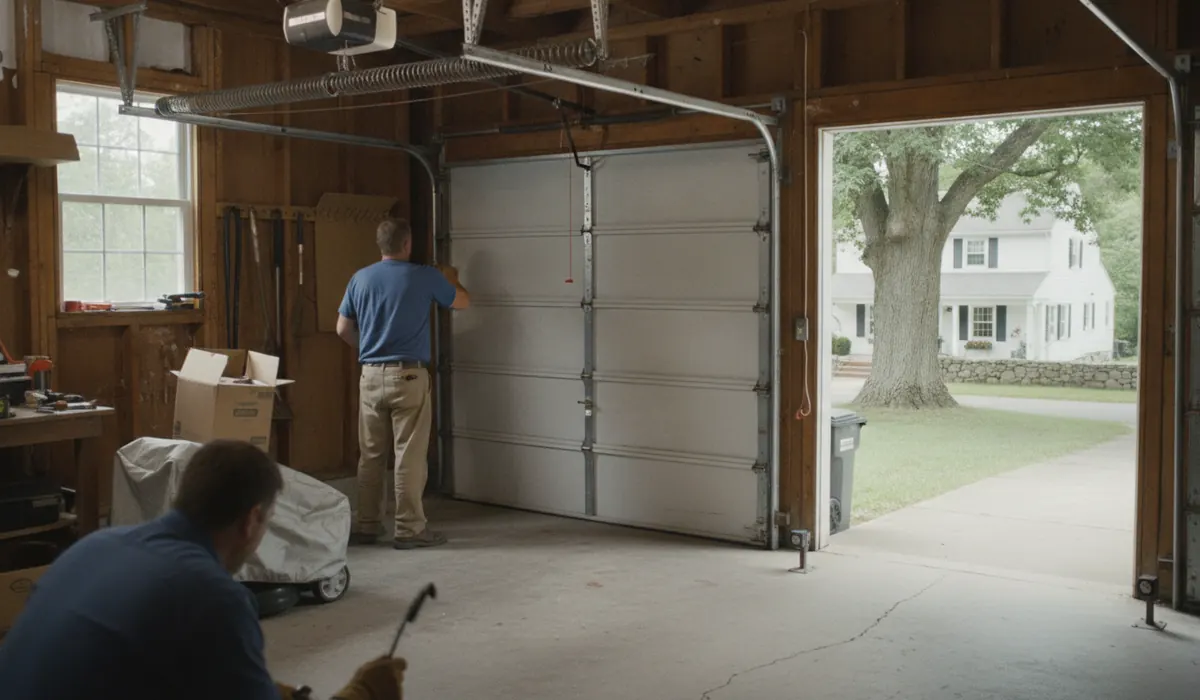
Every sectional garage door uses springs to counterbalance its weight. There are two kinds, and which one your door has affects how long the springs last, how they fail, and what replacement costs.
How each type works
Torsion springs are mounted on a steel shaft above the door opening. As the door closes, the cables unwind from drums on the shaft and twist the springs tighter; as it opens, the springs unwind and turn the drums, lifting the door. Most residential doors have one or two.
Extension springs run parallel to the horizontal tracks, one on each side. As the door closes, they stretch; as it opens, they contract and pull the cables through pulleys to lift the door. They always come in pairs.
Side-by-side
| Torsion springs | Extension springs | |
|---|---|---|
| Where | On a bar above the door | Along each horizontal track |
| Typical cycle life | 10,000 – 20,000 cycles (about 8–15 years) | 8,000 – 15,000 cycles (about 7–12 years) |
| Replacement cost | $75 – $150 per spring | $50 – $100 per spring |
| How many | One or two | Always two |
| When one breaks | Stays on the shaft | Can whip loose without a safety cable |
| Balance | Smoother, more even lift | More prone to a crooked lift if one side weakens |
| Common on | Most newer doors, heavier doors | Older doors, many single-car detached garages |
Cycle and cost figures: HomeAdvisor, updated June 2026. One cycle is one open and one close.
Safety differences
Both types store a lot of energy and both are dangerous to adjust or replace without training. The difference is how they fail. A broken torsion spring stays on its shaft. A broken extension spring, if it has no safety cable through it, can fly across the garage. That’s why safety cables matter so much on extension-spring doors, and why many older Connecticut garages, especially detached single-car garages behind postwar capes and multi-family houses, are worth a look.
Converting from extension to torsion
HomeAdvisor prices an extension-to-torsion conversion at $400 to $800. It’s worth considering when:
- Both extension springs are worn out and need replacing anyway.
- The door is in good shape and you plan to keep it for years.
- The door lifts unevenly or the springs lack safety cables.
It’s less worthwhile on an old door with damaged sections or rot, where that money is better put toward a new door.
Getting the size right
Whichever type you have, the replacement must be sized to the door’s weight and height. The garage door industry’s DASMA technical guidance warns that a spring that doesn’t match the door’s counterbalance requirement shortens the life of the door and the opener, and that extra weight added to a door, such as insulation, can push it past what the original springs were sized for. A good technician measures or weighs the door rather than just matching the old spring.
For prices and red flags, see our spring replacement cost guide. For the repair itself, see garage door spring repair.
The bottom line
If you need garage door help now, call (860) 791-1424 and we'll try to connect you with a participating independent garage door company that serves your area. That company inspects the door and quotes the job itself. Until then, keep people and cars out from under the door and don't touch the springs or cables.