
Learn
Yes. A broken spring means the door's full weight is no longer counterbalanced, so the door can drop suddenly, the opener can burn out lifting it, and the remaining spring and cables are still under high tension. Leave the door closed if it's closed, unplug the opener, keep everyone clear, and have a technician replace the spring.
Published 2026-10-11 · Updated 2026-10-11
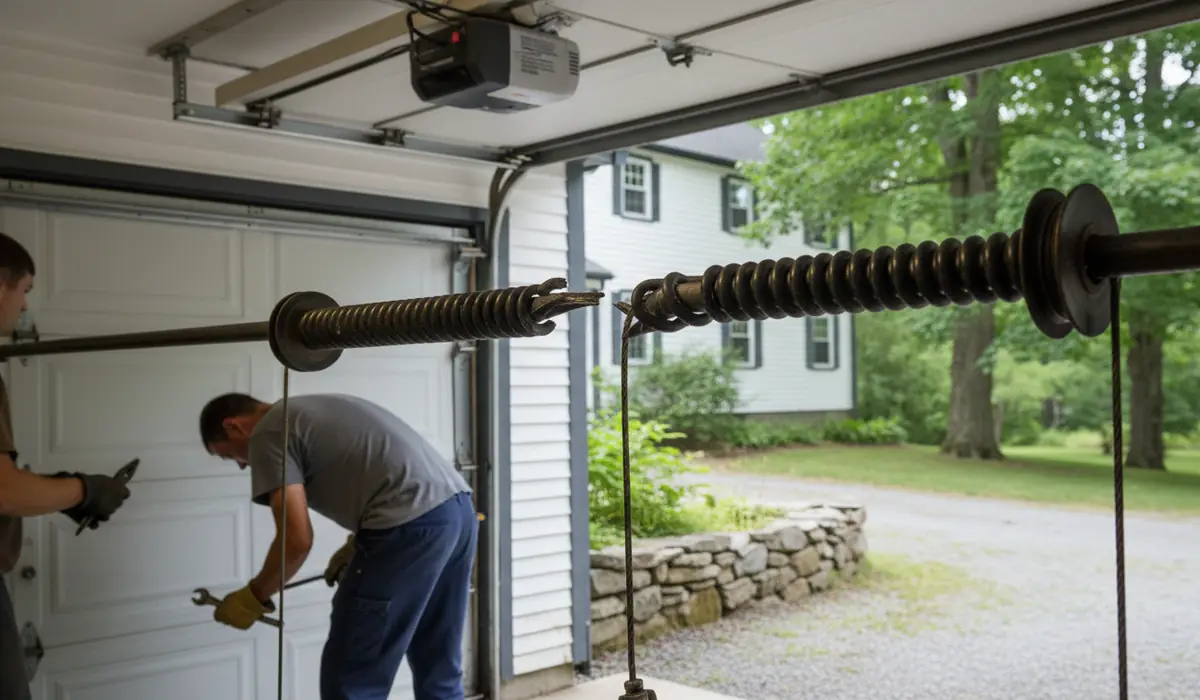
Garage door springs don’t look dangerous, but they’re the most hazardous part of the door. Here’s why, how to know one has broken, and what to do until it’s fixed.
Why springs are dangerous
A garage door is heavy, and the springs counterbalance almost all of its weight. That’s why a working door feels light when you lift it by hand and why a small opener motor can move it. To do that, the springs store a lot of energy: torsion springs are wound tight on a bar above the door, and extension springs are stretched along the tracks every time the door closes.
That stored energy is the hazard. When a spring breaks, it releases suddenly, which is the bang people hear. And the parts connected to it, the cables, the drums, and the bottom brackets at the door’s lower corners, remain under tension from whatever spring is still intact.
How to tell a spring has broken
- A loud bang from the garage, often when nobody was using the door.
- A gap in the coil of a torsion spring on the bar above the door.
- An extension spring hanging loose along one of the side tracks.
- The door won’t lift, or the opener hums, lifts it a few inches, and stops.
- The door goes up crooked, or slams down fast near the floor.
- Cables hanging slack beside the door.
What’s safe to do until it’s fixed
- If the door is closed, leave it closed.
- Unplug the opener so nobody runs it.
- If the door is stuck open, keep people, pets, and cars out from under it, and close the door between the garage and the house.
- Don’t pull the red emergency release with the door open. Without its spring, the door can drop all at once.
- Don’t try to lift the door by hand. It may be far heavier than you expect.
- Don’t touch the spring, the cones, the cables, or the bottom brackets.
Why it isn’t a DIY job
Replacing a torsion spring means releasing the tension on the old one and winding the new one to the right number of turns for your door, using winding bars. The garage door industry’s own technical guidance, DASMA Technical Data Sheet 190, lists winding a spring backward, applying the wrong number of turns, and fitting a spring that doesn’t match the door’s weight as safety issues for the installer and causes of early failure. If professionals are warned about it, it isn’t a weekend project.
Extension springs are lower-tension per spring but still dangerous, especially without a safety cable running through each one. If yours don’t have them, ask the technician to add them.
What the repair costs
HomeAdvisor’s June 2026 data puts spring replacement at $150 to $350 (average $250), with torsion springs at $75 to $150 each and extension springs at $50 to $100 each. On a two-spring door, replacing both is normal. Our spring replacement cost guide has the details, including the price red flags, and our spring repair page explains what the visit involves.
Before anyone starts work, ask for the company’s Connecticut HIC registration number and a written price. Connecticut requires both for home improvement work over $200.
The bottom line
If you need garage door help now, call (860) 791-1424 and we'll try to connect you with a participating independent garage door company that serves your area. That company inspects the door and quotes the job itself. Until then, keep people and cars out from under the door and don't touch the springs or cables.